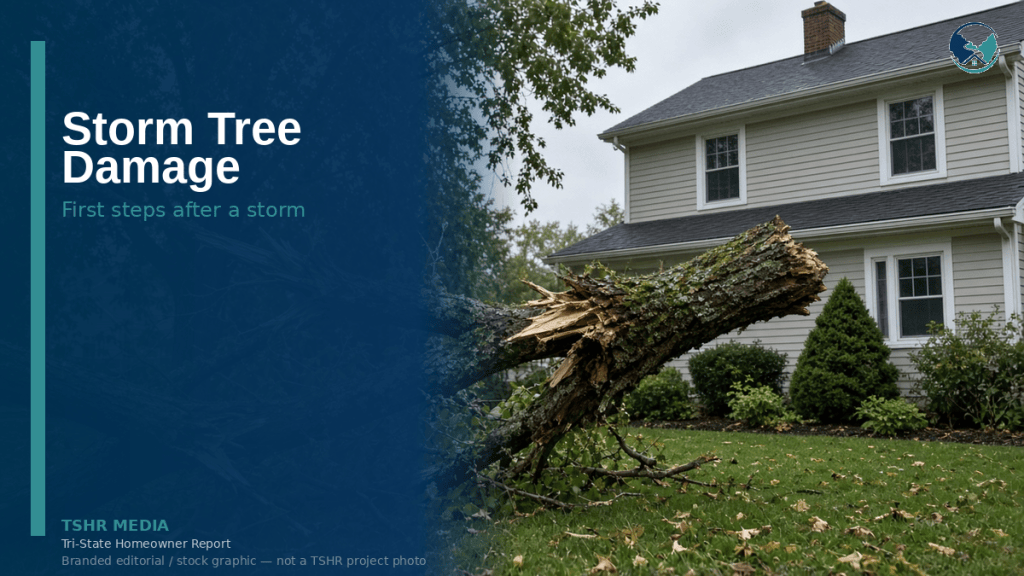
Your **first job is not pruning**—it is **not getting hurt**. This checklist walks Tri-State homeowners through safety, documentation, triage, and hiring without turning TSHR into a tree service. We are a homeowner report and matching service, **not** an arborist company.
For broader readiness, keep the [storm-prep cornerstone](/tri-state-storm-prep-tornado-flood/) handy. For roof impacts after trees hit shingles, see [roof repair vs replace](/roof-repair-vs-replace-tri-state/). Hiring basics live in the [contractor checklist](/how-to-hire-a-contractor-tri-state/).
Step 0: Wait until the scene is safe
- Stay inside during warnings; only assess when the storm has passed and local officials have not told you to shelter or evacuate.
- Watch for **downed power lines**. Treat every downed line as live. **Do not** drive over lines, touch trees touching lines, or “help” by moving wires. Call your utility / emergency number. Illinois Extension and ISA consumer materials both stress this.
- Keep people and pets away from cracked trees, hanging limbs, and partially uprooted trunks—failures can happen hours or days later.
ISA’s storm-damage consumer guidance (TreesAreGood / International Society of Arboriculture) prioritizes hazards: hanging limbs, uprooted trees resting in other trees or on structures, and wood under tension that can spring when cut.
Step 1: Life safety and utilities before property
Priority order:
- Injuries → call emergency services.
- 2. Electrical hazards → utility.
- 3. Gas smell or structural collapse risk → emergency services / utility.
- 4. Road blockage affecting emergency access → local non-emergency / public works as appropriate.
- 5. Then property documentation and tree triage.
If a tree is on a neighbor’s service drop or across a shared fence, document and communicate—don’t start cutting into an electrical corridor.
Step 2: Document before you clear everything
For insurance:
- Photograph wide shots and close-ups of tree damage, roof/siding impact, vehicles, and fences.
- Note date/time and weather event.
- Avoid discarding large debris until your insurer says it is OK—unless it blocks safe egress (then document thoroughly first).
- Do **not** hire the first cash-only crew that knocks after a regional disaster without verifying identity, insurance, and scope—storm chasing is a known risk. Penn State Extension and ISA both warn about unqualified “tree specialists” who appear after storms.
Step 3: Triage what you can safely handle
**Often homeowner-OK (ground-level only, no lines, stable footing):**
- Clearing small loose branches from lawns and driveways with gloves and eye protection.
- Raking light debris.
- Closing off areas under hanging limbs with tape/cones so nobody walks under them.
**Not homeowner work:**
- Chainsaw work on wood **under tension**, storm-twisted trunks, or trees against houses.
- Any limb near **service drops** or primary lines.
- Climbing damaged trees.
- Cutting a tree that is holding up another tree or resting on a roof (load paths can shift suddenly).
Illinois Extension recommends having a **tree care professional or certified arborist** assess damage after the obvious safe cleanup: identify hazards, decide salvage vs. removal, and prescribe proper pruning so the tree can **seal** wounds (trees seal; they do not “heal” like skin).
Step 4: Know the hazard flags
Call a qualified arborist sooner if you see:
- **New lean** after the storm, especially with soil heaving or lifted roots
- Split trunks or major cracks
- Large hanging (“hanger”) limbs over homes, play areas, or sidewalks
- More than a substantial portion of the canopy broken (Iowa State Extension education discusses severe top loss and major bark loss around the trunk circumference as common removal triggers—site-specific judgment required)
- Tree or large limb **on a structure**
- Mushrooms/decay already present plus new storm wounds (higher failure risk)
ISA advises checking seemingly undamaged trees near people or property after severe events for cracks, hangers, and soil movement.
Step 5: Hire carefully (ISA Certified Arborist)
Look for:
- **ISA Certified Arborist** (search tools via treesaregood.org / ISA directories)
- Proof of **liability insurance** and workers compensation (or lawful exemption)—get certificates
- Written scope: hazard reduction, pruning standards, removal, stump grinding, haul-away, crane needs
- Clarification of who handles **permit** issues for right-of-way trees (city/county trees are often not yours to cut)
Get more than one bid when the situation is stable. If a tree is actively failing onto a living space, emergency rates may apply—still ask who is insured to be on your roof or lot.
Compare local pros through [the contractor directory](/contractor-directory/) or [request a contractor](/request-a-contractor/). Read scopes with [How to Read a Contractor Quote](/how-to-read-a-contractor-quote/).
Step 6: Roof, gutters, and secondary damage
After tree impact:
- Look for punctures, bruised shingles, bent gutters, and soft decking from the ground or with binoculars.
- Interior water stains after the next rain are a clue—dry wet materials quickly (EPA moisture timing) and call roofing help as needed.
- Clear gutters once it is safe ([gutter fall prep](/gutter-maintenance-fall-prep-tri-state/)).
- Check fences, AC condensers, and windows for impact damage—without expanding into product pitches.
Step 7: Decide salvage vs. replace (with an arborist)
Extension educators note storms can be opportunities to remove chronically poor species and **replant with diversity**, including natives suited to your site and USDA hardiness zone. Ask:
- Is the tree otherwise healthy?
- How much vascular tissue/bark is lost?
- Are major limbs gone?
- Is the species desirable for this location?
- Is the structure (central leader, balance) still sound?
Patience helps when the tree is **not** an immediate hazard—second opinions beat panic removals sold at the curb.
Cost variables only
- Size/species and proximity to structures
- Crane or bucket-truck access
- Power-line coordination
- Emergency vs. scheduled work
- Stump grinding and haul-away
- Right-of-way vs. private tree responsibility
- Wood disposal vs. leaving rounds for firewood (if safe/allowed)
No invented Tri-State removal prices here.
Next steps
- Refresh your family severe-weather plan via [storm prep](/tri-state-storm-prep-tornado-flood/).
- Put arborist inspection after major wind events” on your mental seasonal list alongside the [maintenance calendar](/evansville-fall-home-maintenance-calendar/).
- [Subscribe](/subscribe/) for more Tri-State homeowner guidance.
Bottom line
After Tri-State storms: **lines and hanging wood first**, document next, clear only what is safe on the ground, then bring in an **ISA Certified Arborist** for anything structural, aerial, or electrified. Panic cutting causes injuries; patience and credentials protect people and the trees worth saving.
Sources
- ISA / TreesAreGood — Storm-Related Tree Damage (PDF)
- University of Illinois Extension — After the storm: Repair and care for damaged trees
- Iowa State University Extension — How to Manage Storm-Damaged Trees
- Penn State Extension — Helping Trees Recover After Storms
- EPA — Brief Guide to Mold, Moisture (dry wet materials promptly)
Find a local contractor
Browse the Tri-State contractor directory by trade, or tell us what you need and we will hand it to one local contractor in your area. Free to you — contractors pay us, you never do.

Leave a Reply