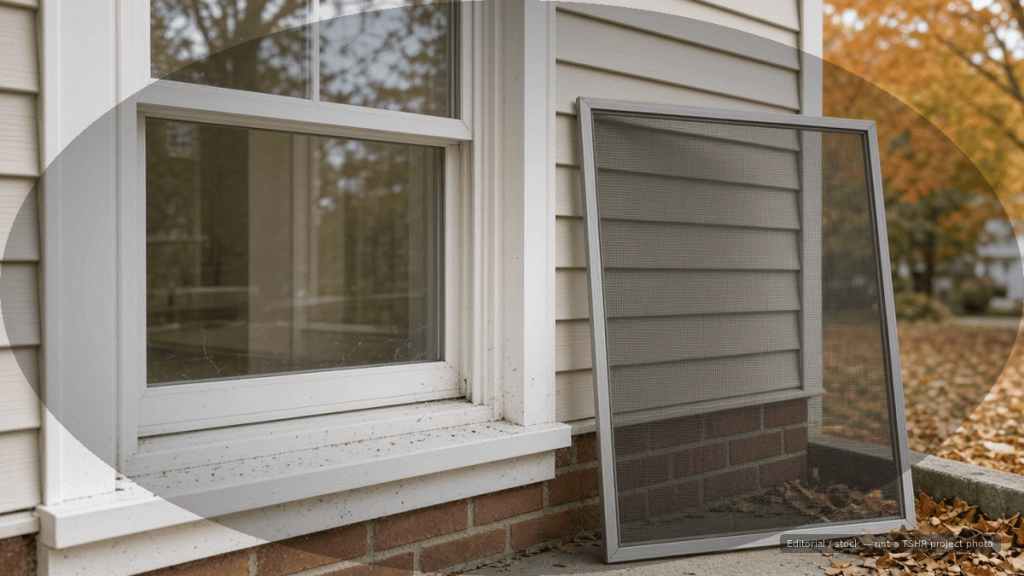

Window screens are the one part of a Tri-State house that works hard for six months and then sits in the weather for six more. Taking them down in autumn is not fussiness — it is the difference between screens that last fifteen years and screens you replace every four. Here is the routine, and the ten minutes of inspection that tells you what needs fixing before spring.
Why take them down at all
Three reasons, in order of how much money they save you. Screens left up through a wet Ohio Valley winter hold moisture against the frame and the sash, which is how wood windows rot from the outside in. Freeze-thaw cycles work the spline loose and stretch the mesh. And a screen in place cuts the winter sunlight coming through the glass, which is free heat you are paying to replace.
The routine: label, clean, dry, inspect, store upright
1. Label before anything else
Screens are not interchangeable, even when they look it. Write the room and the position on the frame edge with a permanent marker — “kitchen, left” — or put a strip of masking tape on the frame. Do it as you take each one down, not afterwards from memory. The spring morning you are trying nine screens against seven windows is the morning you wish you had.
2. Clean them flat
Lay the screen flat on grass or a couple of sawhorses — never leaning upright, which is how mesh gets pushed out of shape. Warm water, a squirt of dish soap, a soft brush, worked gently in one direction. Rinse with a garden hose at normal pressure. Skip the pressure washer entirely; it will blow mesh out of the spline and dent aluminum frames.
3. Dry completely
Stacking damp screens is how you get mildew on the mesh and corrosion where the frame corners meet. Leave them flat in the sun for an hour, or stand them in a garage with air moving for a few hours, until the frame channels are dry to the touch.
4. Inspect while it is flat in front of you
This is the ten minutes that matter. Check four things:
- Mesh. Hold it up to the light. Pinholes, a slack belly in the middle, or a tear at a corner all mean a rescreen. Mesh is cheap; doing it in November on a workbench is far easier than in May with bugs already inside.
- Spline. The rubber cord holding the mesh in the frame channel. If it is brittle, cracked, or lifting anywhere, it will fail over winter. Replace the whole run, not the inch that looks bad.
- Frame corners. Push gently on opposite corners. Any racking or play means the corner keys are loose or broken — an easy fix now, a bent frame by spring.
- Hardware. Clips, tabs, plungers and pull tabs. Missing hardware is why a screen ends up in the flower bed after the first storm.
5. Store upright, off the floor, in order
On edge, like records — never stacked flat, which presses the mesh permanently, and never leaned against a wall at an angle, which bows the frames. Put a scrap of cardboard or foam between each one so frames do not scratch. Keep them off a concrete floor, where moisture wicks up: a couple of furring strips or a shelf is enough. Garage, basement or shed are all fine as long as they are dry and nothing gets stacked on top of them.
While the screens are off
You have clear access to the window exterior for the first time all year. Take the extra five minutes per opening: clean the glass, check the exterior caulk bead for gaps or cracking, run a finger along the sill for soft spots, and clear the weep holes at the bottom of vinyl and aluminum frames — they are usually full of dirt, and blocked weeps are a common cause of water sitting in the track.
If you run storm windows, this is the changeover moment. Screens down, storms up, in one pass rather than two trips up the ladder.
When it is worth calling someone
Rescreening a handful of standard windows is a genuine DIY job. Get help when the count is high, when the openings are on a second storey, when frames are bent rather than just loose, or when the sill under a screen turns out to be soft — that last one is a window problem, not a screen problem, and it does not improve by waiting.
Find a local contractor
Browse outdoor living contractors in the Evansville Tri-State, or tell us what you need and we will hand it to one local contractor in your area. Free to you — contractors pay us, you never do.

Leave a Reply