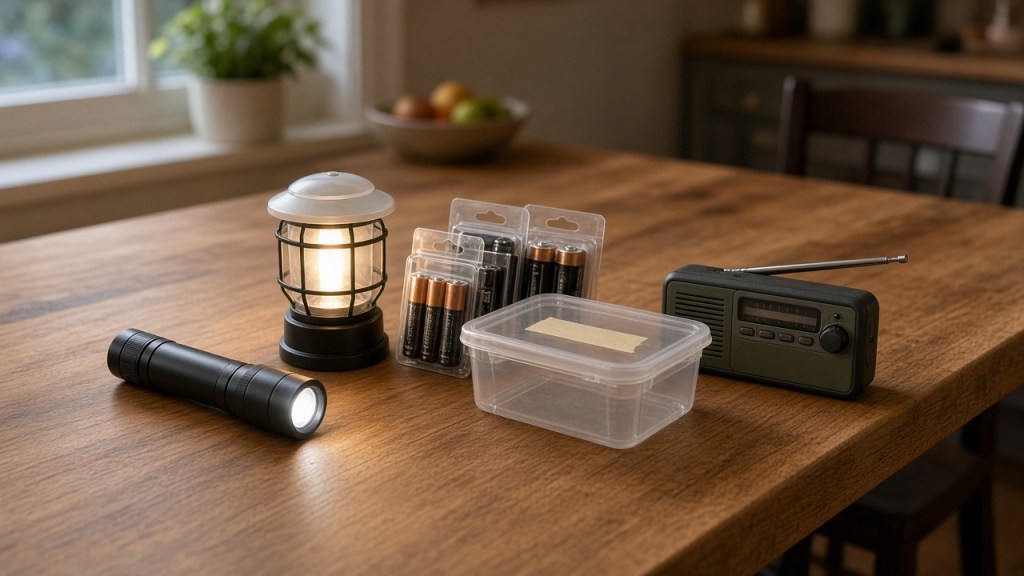

When the first ice warning hits and the only “flashlight” in the junk drawer is a phone with 12% charge, Owensboro and Henderson, Princeton and Boonville, Tell City and Newburgh, and Carmi homeowners need a light-and-battery habit—not another full go-bag rebuild. Across the ~60-mile Tri-State—Evansville as the hub, plus Mount Vernon IN (Posey County) and Mount Vernon IL (Jefferson County—different city)—fall outages and darker evenings make dead AA/D cells and forgotten lanterns a soft, fixable readiness gap.
This guide is a flashlight and emergency-kit battery refresh framed with Ready.gov Build a Kit / maintain-your-kit guidance and outage lighting safety. It is not a full emergency-kit rebuild (water, food, NOAA radio, car kit), not a first-aid supply guide, not medical advice, and not a fake Tri-State “readiness package” price list. For the bigger picture, see Tri-State storm prep. Tri-State Homeowner Report is homeowner media and a matching service—not an EMA or utility. When you want local help, browse the contractor directory or request a contractor; for seasonal reminders, subscribe.
Why lights and batteries deserve their own check
Ready.gov’s basic disaster supplies kit lists flashlight and extra batteries as distinct line items beside water, food, radio, and a first aid kit. A full kit refresh covers the whole kit (dead flashlight batteries are one common summer-heat failure), and a first-aid refresh covers bandages and medical supplies. This article zooms into working light: which lights live where, which chemistries are still fresh, how many spare cells match each device, and why outage lighting should stay battery-powered—not candle-first.
CDC power-outage guidance: use battery-powered flashlights and lanterns rather than candles, gas lanterns, or torches to minimize fire risk. NFPA candle safety education: have flashlights and battery-powered lighting ready during a power outage—never use candles as the outage plan. Ready.gov power-outage info themes likewise point to flashlights/lanterns and battery-powered lights for fire-safe lighting.
Soft inventory map (home / car / work)
| Location | Soft goal | Battery note |
|---|---|---|
| Home kit bin | ≥1 working flashlight or lantern per household plan; spares in the same bin | Match cell type to device; bag spares dry |
| Beside beds / hall | Grab light without hunting the basement | Test monthly soft cue with smoke/CO battery weekends |
| Car kit | Light for roadside / stranded themes (car kit) | Heat/cold age batteries faster—check ~every 6 months with car kit |
| Work grab-and-go | Ready.gov ~24-hour shelter-at-work theme | Small light + spare cells in the case |
| NOAA / hand-crank radio | Extra batteries if battery-powered (Ready.gov) | Do not raid radio cells for the flashlight without replacing |
Ready.gov kit storage: home kit in a designated place everyone knows; work and car kits because you may not be home when trouble starts.
Soft battery refresh checklist
- Gather every kit light—flashlights, headlamps, lanterns, and any “emergency” stick lights still in drawers.
- Turn each on—dim, flicker, or dead = refresh cells or retire the light.
- Open battery compartments—remove leaking, corroded, or partially used cells; wipe contacts; replace with fresh matched chemistry.
- Match sizes—AA, AAA, C, D, CR123, or proprietary rechargeable packs—label spare bags by size.
- Spare count soft rule: enough fresh cells to fully reload each critical light once, stored with the kit—not loose in a humid basement.
- Rechargeables: top off lithium-ion lanterns / power banks on a fall calendar; store at maker-recommended charge if stated; keep a non-rechargeable backup light for when wall power (and therefore recharge) is gone for days.
- Date the bag—painter’s tape with month/year of last refresh; Ready.gov says replace expired items as needed and re-think needs every year as the household changes.
- Do not mix old and new alkaline cells in the same device; do not mix chemistries (alkaline vs lithium primary) unless the maker allows it.
- Phone light is a backup, not the plan—Ready.gov still lists flashlight + extra batteries; cold, dead phones fail mid-outage.
- Whistle / radio soft check while the bin is open—they live in the same kit—without turning this page into a full food/water rebuild.
Soft cadence (Tri-State reality)
| Cue | Soft action |
|---|---|
| Twice-yearly clock change / fall heating start | Full light + battery walk |
| After any real outage | Replace used cells the next day |
| Car kit ~6 months | Car-kit staple; batteries hate trunk heat |
| New household member / new floor of house | Add a light; update who knows where kits live |
| Kids’ sports / camping season ends | Return borrowed kit lights; refill raided cells |
Maintenance educators often suggest checking kits about every six months and replacing even unused batteries on a multi-year shelf schedule per package dating—always follow the cell maker’s printed guidance over folklore.
Flashlight-not-candles (outage fire soft)
When power fails:
- Prefer flashlights, lanterns, and battery-powered lights (CDC / Ready.gov / NFPA themes).
- Skip candles as the outage plan—candles remain a leading home fire cause, and outages are the wrong time to improvise open flame.
- Keep the path to your fire extinguisher clear.
- Generator users: generators stay outdoors only, away from windows and doors—lighting choices do not replace carbon monoxide safety.
Soft DIY vs soft-match
Homeowner-scale when: You can inventory lights, buy matching cells, and restock bins.
Soft-match / escalate when: Medical-device backup power is involved (UPS or battery backup)—coordinate with clinicians and equipment makers, not a flashlight aisle alone; whole-home generator planning belongs with a licensed electrician. Browse the contractor directory or request a contractor for electrical readiness projects—not for buying AA cells.
ESTIMATE note (no fake Tri-State prices)
Flashlights, lanterns, alkaline/lithium cells, and rechargeable power banks are national retail ESTIMATE items until you have a local shelf price. Ready.gov “several days” supply framing and NFPA/CDC lighting safety themes are education, not a guarantee of outage length on your feeder. No invented Evansville / Henderson / Owensboro “family light kit” package prices appear here.
Permits / AHJ: This article omits permit language. Battery refresh and flashlight stocking are not framed as building-permit topics.
Soft sources & further reading
- Ready.gov — Build a Kit (flashlight; extra batteries; maintain kit; replace expired items; rethink needs yearly; home/work/car storage)
- Ready.gov — power outage info themes (flashlights / battery-powered lights; fire-safe lighting)
- CDC — What to Do to Protect Yourself During a Power Outage (battery-powered flashlights/lanterns rather than candles)
- NFPA — candle safety education (have flashlights ready for outages; never use candles as the outage plan)
Make it a fall habit
Run “test lights → dump bad cells → match spares → date the bag → flashlight-not-candles” as the fall battery habit. Subscribe for seasonal reminders. When backup power for medical or whole-home needs goes beyond a lantern aisle, browse the contractor directory or request a contractor.
