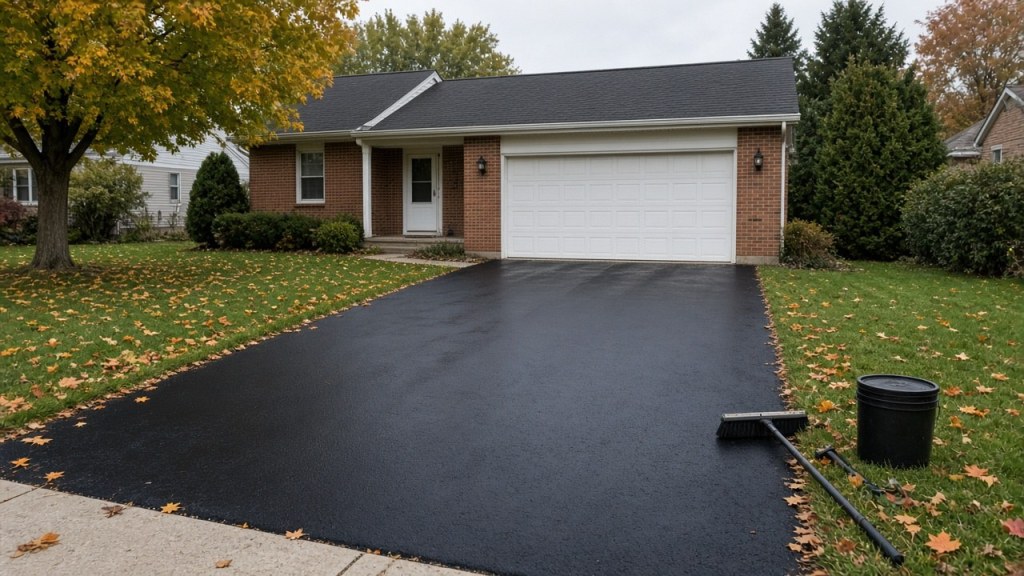
A warm October afternoon can tempt Owensboro and Henderson, Princeton and Boonville, Tell City and Newburgh, and Carmi homeowners into a last-minute asphalt sealcoat, and then a 40°F night peels the job by spring. Across the ~60-mile Tri-State (Evansville as the hub, plus Mount Vernon IN in Posey County and Mount Vernon IL in Jefferson County, a different city), fall driveway sealcoat timing comes down to temperature and dry-cure windows more than whichever weekend you happen to have free.
This guide covers asphalt sealcoat timing in the fall. It is not about sealing a concrete driveway (a different product class), it is not a crack-repair how-to, and it is not a winter ice-melt guide, though all three come up below. For the rest of your autumn list, see our fall home maintenance calendar. Tri-State Homeowner Report is homeowner media and a matching service, not a paving contractor. When you want local help, browse the contractor directory or request a contractor; for seasonal reminders, subscribe.
What this caution is (and is not)
| Habit | What it is | What it is not |
|---|---|---|
| Sealcoat timing | The weather window for an asphalt emulsion or pavement sealer | Silane or siloxane “sealing” for concrete |
| Fall caution | Skipping sealcoat when nights fall below the product’s cure floor | A rule to never sealcoat in autumn if a true warm, dry stretch remains |
| Prep order | Clean and crack-fill before the coat | Coating over open cracks and hoping |
| Winter layer | Sealcoat is separate from ice-melt choices | Permission to dump chloride salts on a fresh film |
Pavement-sealer manufacturer and industry application specs commonly call for air and pavement temperatures of at least about 50°F and rising, with temperatures not expected to drop below about 50°F for roughly 24 hours after application, and no rain in that cure window. Labels vary; some want warmer pavement or a longer dry forecast. Water-based emulsion films need evaporation time to cure, and cold nights and early frost are the classic Tri-State failure for late-season coats.
Timing cues to watch
| Cue | What it means | First move |
|---|---|---|
| Day highs above 50°F but nights in the 40s | The cure floor is at risk | Delay the sealcoat; crack-fill only if that product’s label allows |
| First frost already hit | The season is effectively closed for most water-based sealers | Plan for spring and focus on winter habits |
| Leaf drop and wet pavement | Bonding and curing both suffer | Blow and clean, then wait for fully dry asphalt |
| Open cracks or alligatoring | A coat won’t knit failed pavement together | Fill cracks or get repairs first |
| Asphalt less than about 90 days old (often longer) | Oils are still curing; many labels say wait | Follow the installer’s and sealer’s guidance |
| Concrete driveway | Wrong product class | Use a concrete sealer instead |
| Warm spell after Thanksgiving | A few nice days aren’t a full cure season | Wait for spring rather than forcing a late coat |
A homeowner-scale fall decision path
- Confirm the surface is asphalt, not concrete. Gray broom-finished slabs need a concrete sealer. Black asphalt aprons are what this article covers.
- Read the technical data sheet for your product: temperature floor, rain hold-off, when traffic can return, and whether two coats are specified.
- Check a 24 to 48 hour forecast for lows, frost, and rain, not just the afternoon high on application day.
- Inspect and repair first. Industry best practices repeat the same order: clear debris, treat oil spots, fill roughly ¼ to ¾ inch cracks with an approved crack sealant, and replace failed sections rather than painting over alligatoring.
- Apply only on clean, dry pavement inside the product’s temperature band, and keep cars off for the labeled cure (often about 24 hours at minimum; cool, humid, or shaded drives need longer).
- If the window is gone, stick to crack maintenance and gentle winter traction habits, then sealcoat in late spring or summer when nights reliably hold the cure floor.
Indiana-climate paving education often describes a practical asphalt sealcoat season from roughly late spring through early fall (commonly about May into September or early October), with late summer and early fall as a good window if temperatures still cooperate, and late autumn as a gamble when overnight freezes arrive before the film finishes curing. Treat that as general climate framing, not a rule for your exact street.
How sealcoat fits with the rest of driveway care
| Task | What it does | How it relates to sealcoat |
|---|---|---|
| Concrete sealing | Protects porous concrete from freeze-thaw and deicers | Different surface and product; not interchangeable |
| Crack fill | Keeps water out of joints before freeze | The prep step: fill before you coat |
| Ice-melt choices | Winter traction chemistry | A winter companion, not a sealer substitute |
| Pressure washing | Cleans the surface | Useful prep, but don’t blast a fresh film |
Sealcoat is a thin protective film on asphalt. It does not rebuild a failed base, stop settlement, or fix drainage that ponds after every rain. If your driveway or patio is concrete, our concrete patio basics on drainage covers the slab side of the story.
DIY or bring in a pro?
Homeowner-scale when: it’s a small residential asphalt apron, the product label is clear, the forecast holds the cure floor, cracks are already addressed, and you can keep cars off for the full dry window.
Worth a pro when: large or alligatored areas, oil-softened pavement, drainage that ponds every rain, commercial spray equipment, or you missed the temperature window and want a written spring plan. Browse concrete and driveway pros in our directory or request a contractor, and our guide to reading a contractor quote helps when the bids come in.
A note on cost
Sealer, crack filler, and contractor sealcoat visits are national retail and service estimates until you have a local quote. Resealing is commonly discussed on roughly a 2 to 5 year cycle in consumer paving education, depending on product and traffic; treat that as a rough habit, not a guarantee for your driveway. We don’t publish made-up Evansville, Henderson, or Owensboro per-square-foot sealcoat prices. Ordinary residential driveway sealcoat isn’t typically treated as a building-permit project.
Sources and further reading
- Pavement-sealer manufacturer application specs (about 50°F and rising; no drop below about 50°F and no rain for about 24 hours; traffic after the labeled cure)
- Industry sealcoating best-practice guidance (pavement at or above about 50°F, dry weather, crack prep before coating)
- Indiana-climate paving education (seasonal window and late-autumn freeze risk before full cure)
- Related on this site: fall home maintenance calendar and fall gutter maintenance
Watch the forecast, not the weekend
Fill cracks first, sealcoat only when asphalt nights hold the label’s cure floor, and switch to winter habits once that window closes. For seasonal reminders like this one, subscribe. When the pavement has failed or the fall window is gone, browse the contractor directory or request a contractor for a spring plan instead of forcing a cold-night coat.
