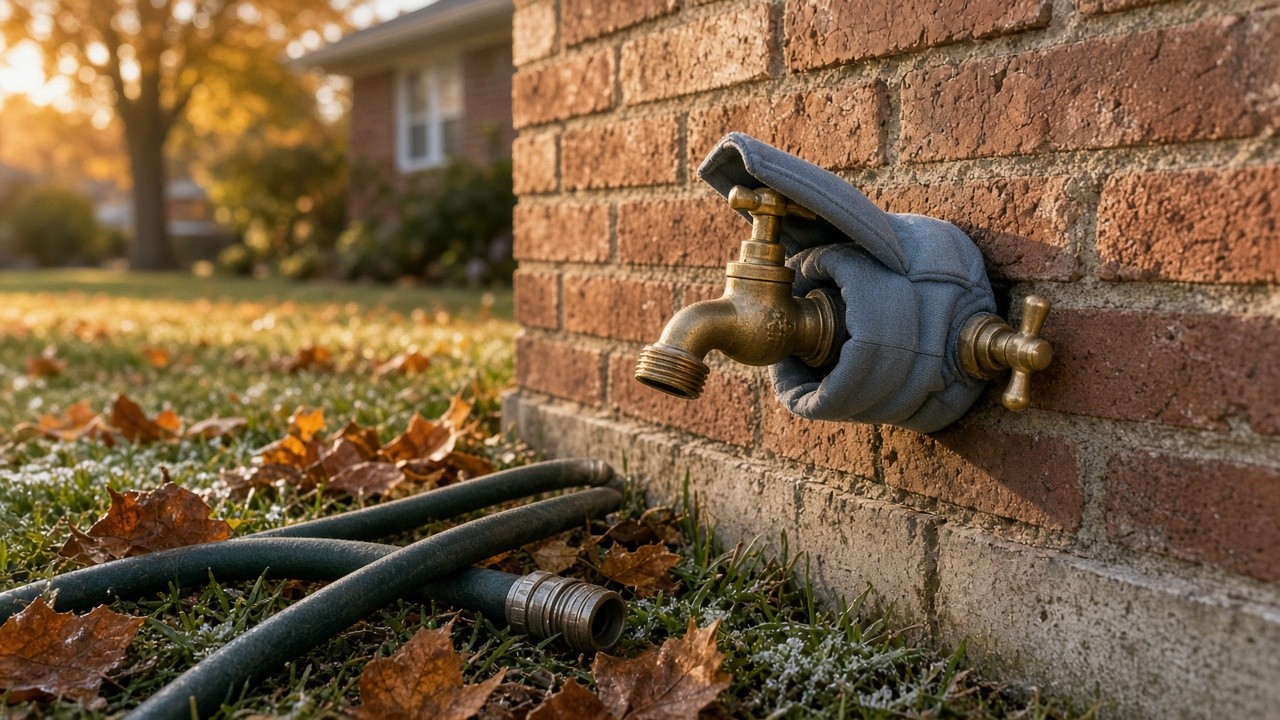
Before the first hard freeze settles over the Evansville Tri-State—Evansville, Newburgh, Chandler, Boonville, Henderson, Owensboro, Princeton, Mount Vernon (IN and IL), Rockport, Tell City, and nearby towns—outdoor hose bibs and exposed supply lines deserve a short fall checklist. Mid-to-late October is when damp freeze–thaw nights often start here. A disconnected hose and a drained sillcock cost almost nothing; a burst pipe does not.
Tri-State Homeowner Report is a homeowner publication and a matching service, not a contractor or plumber. Dollar figures below are ESTIMATE labels from citeable public sources—not local quotes or our own market data.
Browse the contractor directory or request a contractor when you want local pro matches. Subscribe for seasonal reminders.
Why mid-fall faucet & pipe prep matters here
Tri-State winters are milder than the Upper Midwest on average, but arctic dips, damp cold, and freeze–thaw still crack outdoor faucets and stress pipes in unheated crawlspaces, garages, and rim joists. Leaving a garden hose attached is one of the most common mistakes—even on frost-free (freeze-proof) sillcocks—because trapped water cannot drain and can freeze back into the wall.
Public guidance from the American Red Cross is clear and calm: remove, drain, and store outdoor hoses; close inside valves that supply outdoor hose bibs; open the outside faucet so the line can drain; and leave that outdoor valve open so any leftover water can expand without breaking the pipe. The CDC and EPA echo related cold-weather habits: drip faucets on exposed lines during extreme cold, open cabinet doors so warm air reaches under-sink pipes, keep heat on (often discussed at no lower than about 55°F when you are away), and never thaw frozen pipes with an open flame.
Pair this outdoor-plumbing pass with other fall timing already on the site—your fall furnace checkup, gutter maintenance fall prep, and clear-out calendar—so one weekend covers heat, water, and debris.
DIY checklist (safe homeowner tasks)
These are homeowner-level habits—not a substitute for diagnosing a stuck shutoff, replacing a frost-free sillcock behind finished walls, or repairing a burst:
- Disconnect and store every hose — Walk the house: front, back, garage, deck, and side yard. Drain each hose, coil it, and store it indoors or under cover. A connected hose is the classic freeze failure, including on frost-free bibs.
- Find and close interior shutoffs (if present) — Many homes have a small valve in the basement, crawlspace, or utility room where the pipe exits the wall. Close it. If you cannot find one, note that as a future upgrade conversation with a plumber—do not force unfamiliar valves.
- Open and drain outdoor faucets — With the interior valve closed (or after you know the line is isolated), open the outdoor faucet fully and let it drain. Leave the outdoor valve open for winter so residual water can expand safely (Red Cross guidance).
- Add foam faucet covers — Slip-on foam or hard-shell covers are a quick extra layer after draining. They do not replace disconnecting hoses or shutting off interior valves when those valves exist.
- Insulate exposed pipes in unheated spaces — Crawlspaces, garages, attics, and rim-joist runs benefit from foam pipe sleeves (and, where appropriate, UL-listed heat tape/cable per manufacturer instructions). Red Cross notes both hot and cold lines in unheated areas.
- On extreme cold nights — Open kitchen/bath cabinet doors on exterior walls so warmer room air reaches the plumbing; move cleaners out of kids’ and pets’ reach. Let a cold-water faucet drip on the line you worry about most. Keep garage doors closed if supply lines run through the garage.
- Know your main shutoff — Before freeze season, locate the home’s main water shutoff and confirm you can operate it. If a pipe bursts, minutes matter more than tools.
If only a trickle comes out of a faucet, suspect a freeze. Keep the faucet open and thaw with warm air (hair dryer, heating pad, or hot-water towels)—never a blowtorch or open flame. If you cannot find or reach the frozen section, call a licensed plumber.
ESTIMATE bands for covers, upgrades & freeze repairs (national)
Label: ESTIMATE — not Tri-State quotes or our own market data.
| Item / service language in public sources | ESTIMATE band | Source type |
|---|---|---|
| Foam / insulated outdoor faucet cover (homeowner purchase) | Often about $3–$5 each at retail; Angi frames pipe insulation / winterization add-ons near $10–$50 per spigot | Retail listings / Angi outdoor spigot cost (2026) |
| Professional winterization (drain & insulate language) | About $50–$100 per fall visit framing | Angi outdoor spigot cost (2026) |
| DIY outdoor spigot materials | About $30–$100 | Angi |
| Standard hose bib / outdoor spigot replacement (pro, all-in) | Angi about $120–$500 (avg ~$250); HomeAdvisor hose-bib project framing about $200–$600 (avg ~$300) | Angi / HomeAdvisor |
| Frost-free (extended-stem) sillcock replacement | Angi about $180–$350; HomeAdvisor frost-free framing about $150–$500 | Angi / HomeAdvisor |
| Plumber labor / service-call framing | Angi about $50–$150/hr with minimums often $75–$150; HomeAdvisor plumber hourly language about $45–$200/hr | Angi / HomeAdvisor |
| Thaw frozen pipe (no burst) | HomeAdvisor often discusses a flat fee near $100 | HomeAdvisor burst-pipe cost |
| Burst pipe repair | HomeAdvisor normal range about $200–$3,000; average near $500; emergency call-out add about $100–$300 | HomeAdvisor |
| Water-damage cleanup after a burst (separate from pipe fix) | Public plumbing overviews often discuss roughly $1,000–$4,000 when cleanup/restoration is needed | HomeAdvisor plumbing cost overview |
Your Tri-State bid can sit outside any national table. Get written scopes before authorizing wall openings or multi-fixture upgrades.
DIY vs. call a plumber — quick cues
| You can usually handle | Call a licensed plumber |
|---|---|
| Disconnect / drain / store hoses | Outdoor faucet will not shut off or drips from the wall |
| Close known interior shutoffs; open outdoor bibs to drain | No interior shutoff and you want one added |
| Fit foam faucet covers | Cracked sillcock body, persistent leak after washer work |
| Foam-sleeve exposed pipes you can safely reach | Suspected freeze you cannot locate or thaw |
| Know/test the main shutoff location | Burst pipe, ceiling/wall staining, or unexplained high water bill |
| Extreme-night drip + cabinet doors ajar | Any gas-line or structural opening beyond a simple bib swap |
HomeAdvisor’s public guidance still applies: temporary pipe-repair kits are stopgaps while you wait for a pro—not permanent repairs on a freeze failure.
Permit note
Swapping a like-for-like outdoor faucet is often treated as routine maintenance in many jurisdictions. Replacing frost-free sillcocks, relocating lines, opening finished walls, or adding new exterior water connections can trigger local plumbing-permit or inspection expectations. Angi publicly frames permit fees in a broad $25–$100 band (inspections sometimes discussed higher). Confirm with your city or county building department when the scope goes beyond a simple drain-and-cover winterize.
Tri-State planning tips (without the drama)
- Do this before the first freeze forecast — Mid-October is friendlier than the morning after a 25°F night.
- Count every bib — Garage sides, decks, and backyard hydrants get forgotten.
- Frost-free is not “leave the hose on” — Disconnect anyway so the stem can drain.
- Crawlspaces & older ranch homes — Unheated floors and rim-joist runs are common Tri-State freeze points; insulation and air sealing help more than hoping for a mild January.
- Stack fall tasks — Furnace readiness, gutters, and outdoor faucets make one coherent weekend. See the Evansville fall home maintenance calendar and Tri-State Fall Prep Pack 2026 for broader timing.
- Basement moisture is a cousin topic — A burst or slow leak raises humidity fast; our basement moisture & waterproofing guide covers the moisture side if you are already dealing with damp walls.
When to get more than one quote
For a foam cover and a drained hose, you do not need bids. For frost-free upgrades, multiple sillcocks, wall openings, or any burst-pipe repair, get 2–3 written scopes that spell out parts, labor, access, and warranty. Use the how to hire a contractor checklist mindset. If heat-system timing is still open, revisit the fall furnace checkup and, when replacement enters the conversation, the HVAC replacement cost guide.
Ready for local matches? Visit the contractor directory or request a contractor. For more seasonal homeowner timing across the Tri-State, subscribe.
Sources
- American Red Cross — Preventing & Thawing Frozen Pipes (hose disconnect, shutoff/drain, insulation, drip, thaw safely).
- CDC — Stay Safe During & After a Winter Storm (drip faucets, open cabinets, no torch thaw).
- U.S. EPA — Winter Weather and Indoor Air Quality (shut off/drain outdoor spigots; drip; open cabinets; no torch).
- Angi — Outdoor Spigot / Hose Bib Replacement Cost (2026: $120–$500 avg ~$250; frost-free $180–$350; winterization ~$50–$100; insulation add ~$10–$50; DIY materials $30–$100; labor $50–$150/hr).
- HomeAdvisor — Hose Bib Replacement Cost (2026: project ~$200–$600 avg ~$300; frost-free ~$150–$500).
- HomeAdvisor — Burst Pipe Repair Cost (2026: ~$200–$3,000 avg ~$500; thaw flat fee ~$100; emergency call-out ~$100–$300).
- HomeAdvisor — Plumbing Cost overview (leak/burst cleanup framing).
