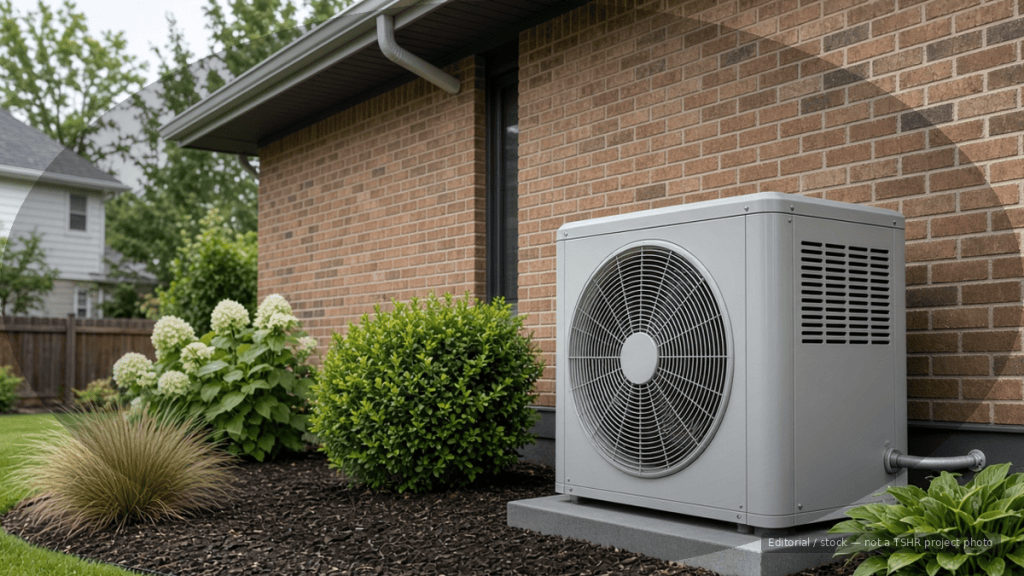
When an Evansville-area furnace struggles through January or the AC quits in August humidity, replacement cost becomes urgent fast. Public cost explainers publish national estimate bands. Your actual Evansville / Henderson / Newburgh bid depends on tonnage, duct condition, electrical/gas work, efficiency tier, and season.
TSHR is an independent local guide and contractor matching service—not an HVAC contractor. Ranges are labeled estimate and are not quotes, guarantees, or TSHR market data.
Browse the contractor directory or request a contractor. Read alongside our replace HVAC before failure cornerstone and seasonal maintenance calendar.
What an HVAC replacement typically includes
A common matched furnace + central AC changeout may include:
- Load-appropriate outdoor condenser and indoor coil / furnace (or heat pump + air handler)
- Removal and disposal of old equipment
- Refrigerant line set work / reconnection as needed
- Thermostat (basic or smart)
- Startup, charging to manufacturer specs, and basic airflow checks
- Permit (where required) and final inspection coordination
Often extra: duct redesign or replacement; zoning; electrical panel/breaker upgrades; new pad or line-set relocation; coil cabinet changes; humidifier/dehumidifier/filtration add-ons; gas-line modifications; attic or crawlspace access premiums.
Ask for a Manual J (or equivalent) load calculation—not “rule of thumb” tonnage alone.
Estimate bands (national public explainers)
These are national ranges — not Evansville contractor quotes.
| Project type | estimate band (installed, national explainers) | Source type |
|---|---|---|
| Full HVAC replacement (broad) | About $5,000–$22,000 depending on scope; Angi cites average near ~$7,500 with many projects lower/higher by type | Angi HVAC replacement cost page |
| Central AC + gas furnace together | Commonly cited around $7,000–$18,000; mid projects often discussed near ~$9,000–$15,000 | Angi; HVACDirect; RemodelFinder-style 2026 explainers |
| Central AC only | Roughly $3,900–$14,000+ depending on size/efficiency (Angi ~$3,900–$7,900 equipment framing; other explainers wider for full install) | Angi; HVACDirect |
| Gas furnace only | Roughly $3,300–$10,000+ installed depending on AFUE and complexity | Angi / industry explainers |
| Ducted air-source heat pump | Often cited about $8,000–$18,000 installed | HVACDirect / RemodelFinder-style ranges |
| Ductwork replacement (if needed) | Commonly discussed as several thousand dollars add-on (Angi example line ~$3,500 optional duct install—treat as estimate variable) | Angi sample breakdown |
Efficiency / lifetime cost context (DOE FEMP / ENERGY STAR purchasing guidance—estimate illustrations, not install prices):
- DOE FEMP notes ENERGY STAR residential central AC can justify up to about $1,853 (2023$) premium vs. a less-efficient model in its illustrated North/life-cycle examples (location tables vary).
- ENERGY STAR furnace examples show lifetime energy cost savings on the order of roughly $549–$1,345 (2023$) vs. less-efficient models depending on climate table.
- Heat-pump FEMP tables illustrate smaller upfront-premium breakeven figures in some scenarios (~$700–$771 in illustrated cases)—local utility rates dominate.
Use DOE/ENERGY STAR for efficiency shopping, not as a substitute for local installed-price bids. Calculators: ENERGY STAR / DOE heating & cooling resources.
Incentives note (verify current law): Several 2026 explainers state that certain federal §25C credits for qualifying HVAC/heat pumps ended for installs after Dec. 31, 2025. Do not assume a federal credit. Check current utility rebates and any state programs via DSIRE and your utility—programs change.
Cost drivers
- Capacity & efficiency — SEER2 / AFUE / HSPF2 tiers and staging (single, two-stage, variable).
- Duct condition — Leaky or undersized ducts waste equipment money.
- Fuel & system type — Gas furnace + AC vs. heat pump vs. dual fuel.
- Access — Attic, crawlspace, tight mechanical closets.
- Code & refrigerant transition — Newer lower-GWP refrigerants and regional minimum efficiencies affect equipment choices (DOE regional standards).
- Seasonal demand — Mid-summer AC failures compress timelines and options.
- Brand / warranty / maintenance plan — Compare apples-to-apples on labor warranty and what voids it.
Tri-State notes (Evansville climate)
- Humid summers and cold snaps mean both cooling capacity and heating reliability matter. Oversizing can worsen humidity control—another reason to insist on proper load calc.
- Schedule furnace checks in early fall and AC service in spring (see seasonal maintenance calendar).
- After severe storms, protect outdoor units from debris; never run equipment sitting in floodwater—follow manufacturer and electrician guidance.
- Permits: mechanical permits are commonly required for system replacements—confirm with Evansville Building Commission or your county AHJ.
When to get multiple quotes
Get 2–3 written bids with the same design temperature assumptions and:
- Equipment model numbers, SEER2/AFUE, tonnage/BTU
- What happens to existing ductwork
- Line-set, electrical, and thermostat scope
- Permit responsibility
- Labor warranty and manufacturer warranty registration
- Start-up measurements they will provide
Cross-reference our hire-a-contractor checklist and how to read a contractor quote. Prefer calm shopping before peak failure season when possible.
Find local matches in the contractor directory or request a contractor. Subscribe for Tri-State seasonal reminders.
Sources
- Angi — How Much Does HVAC Replacement Cost?
- HVACDirect — 2026 HVAC replacement cost explainer.
- U.S. DOE FEMP — Purchasing energy-efficient residential central air conditioners.
- U.S. DOE FEMP — Residential furnaces.
- U.S. DOE FEMP — Residential air-source heat pumps.
- DSIRE incentive database.
Find a local contractor
Browse HVAC companies in the Evansville Tri-State, or tell us what you need and we will hand it to one local contractor in your area. Free to you — contractors pay us, you never do.

Leave a comment