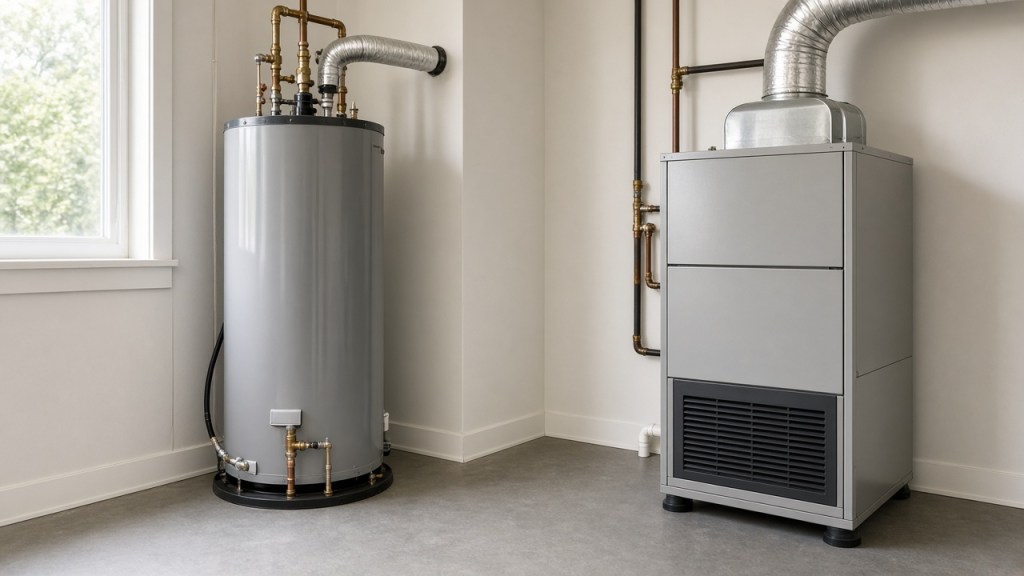
Few home failures feel as sudden as a cold shower—or as messy as a tank that lets go in a finished basement. For Evansville Tri-State homeowners, the repair-vs-replace question usually lands on a busy weekday when you least want a multi-thousand-dollar decision.
This article gives a citeable decision framework: age, leak location, efficiency upgrades, and hiring basics. It is not a price list and not plumbing advice for DIY gas or electric work. Tri-State Homeowner Report matches homeowners with contractors; we are not a plumber.
Cross-read with our HVAC replace-before-failure piece (same “plan before emergency” mindset), the hire checklist, and the seasonal calendar for filter/utility checkups.
How long water heaters typically last
Manufacturer and ENERGY STAR education commonly treat conventional storage-tank water heaters as mid-life appliances. A.O. Smith’s consumer guidance cites an average service life of about 8 to 12 years, varying with installation quality, maintenance, and water quality. ENERGY STAR’s homeowner explainer says that if your unit is more than about 10 years old, it is time to consider replacement before an emergency forces the choice.
Tankless systems are often marketed with longer service lives (commonly discussed in the 15–20+ year range with maintenance)—treat manufacturer literature and a plumber’s inspection as your source of truth for a specific model.
How to find age: Read the data plate. Manufacture date may be printed plainly or encoded in the serial number. ENERGY STAR points homeowners to brand resources and inspector databases for decoding serials.
Evidence label: Lifespan ranges are industry/manufacturer guidance, not a warranty promise for your unit.
Signs that point to repair vs replace
ENERGY STAR lists common red flags:
- Visible corrosion on the tank or fittings
- Water leaking from joints, seals, or seams
- Rust-colored water
- Not enough hot water (sediment reducing capacity)
- Rumbling or unusual noises (often sediment-related)
Lean toward repair when…
- The unit is relatively young (often discussed as under ~6–8 years for tanks).
- The problem is a replaceable part (thermostat, heating element, gas control, T&P valve, anode rod—as applicable).
- There is no tank-body leak.
- Repair cost is clearly a minor share of a full replacement (see heuristic below).
- The unit is still under a meaningful manufacturer warranty for that failure mode.
Lean toward replace when…
- Age is past ~10 years for a conventional tank (ENERGY STAR cue).
- The tank itself is leaking or rusted through—tank shell leaks are not a durable “patch and forget.”
- You are on a second or third repair in a short window.
- Hot-water capacity or recovery no longer matches household needs.
- You want a step-change in efficiency (e.g., heat pump water heater on electric service) and incentives may apply—verify current IRS/utility rules at decision time.
The “~50% of replacement” repair heuristic
Across trade education, a common rule of thumb is: if a repair approaches or exceeds about half the cost of a comparable new installed unit, replacement often wins on remaining life. DOE Building America HVAC renovation materials use a similar “half of replacement framing for major HVAC repairs; water-heater decision articles apply the same logic.
Label: This is an ESTIMATE / decision aid, not code. Get two written quotes—repair scope and replacement scope—before you decide. Local labor, fuel type, permit needs, and access (basement vs. attic vs. garage) swing numbers too much for TSHR to invent Tri-State averages.
Cost variables only (no fake local price bands)
What typically drives installed cost:
- Fuel type: electric resistance, gas, propane, heat pump (hybrid), tankless
- Capacity (gallons) or flow rate (GPM for tankless)
- Location and access; pan, drain, and flood-switch needs
- Venting changes (atmospheric vs. power-vent vs. direct-vent)
- Electrical service upgrades for heat pump or tankless electric
- Code updates: expansion tank, seismic strapping where required, drip pan, T&P discharge path
- Permit and inspection fees (AHJ-specific)
- Haul-away of the old unit
- Emergency after-hours vs. planned swap
Ask every bidder to list equipment, labor, allowances, exclusions, and who pulls the permit. See how to read a contractor quote.
Efficiency upgrades worth understanding
Water heating is a large share of many household energy bills. When you replace:
- Compare Uniform Energy Factor (UEF)—higher is more efficient (DOE labeling).
- ENERGY STAR highlights electric heat pump water heaters (HPWHs) for substantial operating-cost savings versus standard electric tanks. ENERGY STAR publishes example annual dollar savings by household size (national assumptions on kWh price)—treat those figures as ESTIMATE examples, not your CenterPoint or local bill.
- Confirm space, condensate drain, and noise/temperature needs for HPWHs (they move heat from room air).
- Federal tax credits and utility rebates change. ENERGY STAR has pointed to federal credits for eligible heat pump water heaters with a horizon into the early 2030s on its explainer—always verify current IRS Form 5695 / ENERGY STAR Rebate Finder / utility pages before counting dollars. Do not treat this draft as tax advice.
Safety first (non-negotiable)
- Gas smell, scorch marks, or CO concerns: Leave the area, follow utility/emergency guidance, and call qualified help—do not “watch it overnight.
- Never disable a leaking temperature & pressure relief (T&P) valve.
- Flooded heaters and wet electrical components are not DIY experiments.
- If a tank fails catastrophically, shut off water and power/fuel only if you can do so safely, then document for insurance.
Maintenance that buys time (when the tank is still sound)
- Periodic flush to reduce sediment (frequency depends on water hardness and use).
- Anode rod inspection/replacement on many tank models (extends tank life when done in time).
- Keep the area clear; verify the T&P discharge path is unobstructed.
- For tankless: follow manufacturer descaling guidance—hard Tri-State water can shorten heat-exchanger life without it.
These steps help; they do not reverse a rusted-through tank.
Hiring notes for Indiana / Kentucky / Illinois Tri-State
Plumbing is commonly a licensed trade. In Indiana, plumbing licensing runs through the state Professional Licensing Agency / Plumbing Commission framework—verify the person on your job. Kentucky uses state trade licensing hubs (DHBC) plus local rules. Always confirm license, insurance, and permit expectations for your city/county.
Written contracts and clear payment schedules protect everyone—see the hire checklist. When you are ready to compare pros, use /contractor-directory/ or /request-a-contractor/. For ongoing tips, /subscribe/.
Bottom line
Repair young units with isolated part failures. Replace aging tanks—especially past the ENERGY STAR “think about it at 10 years” cue—or any unit with a tank-body leak. Use the half-of-replacement heuristic as a conversation tool with written bids, not as gospel. Plan the swap on your calendar when you still have hot water; emergency Saturday night replacements limit options and raise stress.
Sources
- ENERGY STAR — When Should You Replace Your Water Heater?: https://www.energystar.gov/products/ask-the-experts/when-should-you-replace-your-water-heater
- A.O. Smith — When to Repair or Replace Your Water Heater: https://www.hotwater.com/info-center/when-to-repair-or-replace.html
- DOE / ENERGY STAR product pages for UEF and heat pump water heater education (via energystar.gov)
- DOE Building America — HVAC renovations guide (repair ≈ half of replacement heuristic context): https://www1.eere.energy.gov/buildings/publications/pdfs/building_america/hvac_guide.pdf
- Indiana PLA plumbing licensing hub (verify current): https://www.in.gov/pla/
- Kentucky DHBC: https://dhbc.ky.gov/
 Tri-State Homeowner Report | Evansville Homeowner Guide
Leave a comment