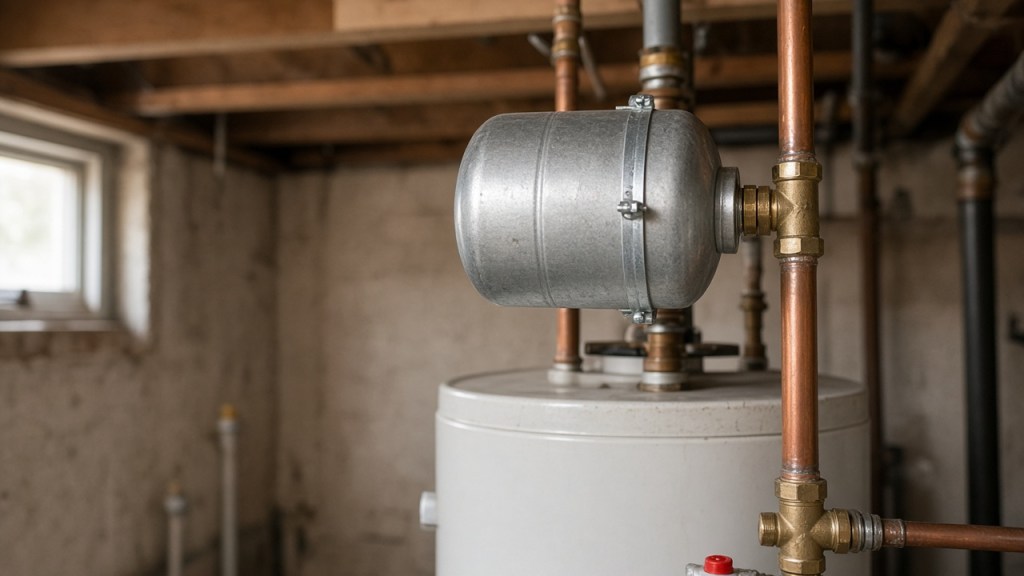
When a small tank hangs on the cold supply above a water heater—or a temperature-and-pressure (T&P) valve starts weeping on every heat cycle—Owensboro and Henderson, Princeton and Boonville, Tell City and Newburgh, and Carmi homeowners often need a thermal-expansion habit, not a full tank swap. Across the ~60-mile Tri-State—Evansville as the hub, plus Mount Vernon IN (Posey County) and Mount Vernon IL (Jefferson County—different city)—many homes are on closed plumbing (pressure-reducing valve, backflow preventer, or meter check valve). Heated water expands; with nowhere to push back into the street main, pressure rises unless an expansion tank (or equivalent provision) absorbs it.
This guide is a water heater expansion tank soft visual check. It is a look-listen-tap soft layer—not a full pre-charge service tutorial for every brand, not a code lecture, and not a fake Tri-State “expansion tank package†price list. Soft call a plumber if unsure is intentional: working near pressurized potable lines and T&P discharge paths deserves caution. Soft companions: water heater repair vs replace, winterize outdoor faucets, and clean a P-trap under the sink. Browse plumbers in the plumbing contractor directory. Tri-State Homeowner Report is homeowner media and a matching service—not a plumber. Soft matching: contractor directory, request a contractor; tips via subscribe.
What this soft visual check is (and is not)
| Habit | What it is | What it is not |
|---|---|---|
| Presence / mounting look | Tank on cold inlet side; supports; obvious rust/leak | Designing a closed-system retrofit from scratch |
| Tap / hollow cue | Hollow “air†sound vs dull waterlogged thud | Claiming tap alone replaces manufacturer service steps |
| Schrader soft caution | Cap present; if unsure, stop—water at valve = failed bladder class | Adjusting pre-charge while the house is fully pressurized |
| T&P weep cue | Weeping T&P as a possible expansion symptom | Disabling or plugging a T&P valve—never |
Manufacturer literature for potable thermal-expansion tanks (Watts PLT-class examples) explains the job: when a water heater heats water in a system isolated by a one-way device, the tank’s pre-charged diaphragm absorbs expanded volume so system pressure stays below the T&P relief setting. Watts product notes commonly frame tanks for potable service with maximums on the order of 150 psi / ~200°F class ratings, field-adjustable pre-charge, and installation on the cold supply to the heater. Factory pre-charge on some series is often cited around 20 psi until set to match measured static supply pressure; makers warn not to exceed roughly 80 psi air charge and not to adjust pre-charge with the system under pressure. Always follow your tank’s label and manual.
Soft visual / cue table
| Cue | Soft read | First move |
|---|---|---|
| No tank + PRV/backflow on service | Closed-system expansion risk | Soft-match plumber—do not DIY invent sizing |
| Rust, wet base, corrosion bloom | Leak / end-of-life | Soft-match; contain drips |
| Tank hangs unsupported from pipe only | Stress on fittings | Soft-match support/strap per maker |
| Dull thud when tapped (vs hollow) | Possible waterlogged / failed diaphragm | Soft-match or follow maker isolate-and-test steps if skilled |
| Water from Schrader valve | Bladder/diaphragm failed—replace tank class | Soft-match; do not “air up†a flooded bladder |
| T&P weeps each heat cycle | Expansion or T&P issue stack | Soft visual check + soft-match; never cap the T&P |
| Banging / pressure spikes at fixtures | Pressure management failing | Soft-match; consider gauge check at hose bib |
Soft visual walk (look first; call plumber if unsure)
- Power and safety mindset: You are inspecting, not rebuilding. If anything looks unsafe (active spray, gas odor, scorched wires), leave and soft-match.
- Find the tank: Usually a small steel vessel (often 2–5 gallon class for residential) on the cold line near the heater—sometimes horizontal, sometimes vertical.
- Confirm cold-side placement at a glance—hot-side “mystery tanks†need a pro read.
- Look for leaks: drips at threads, wet insulation, rust trails, pooled water under the tank.
- Check support: makers expect proper support so the tank’s weight is not carried only by soldered or threaded fittings.
- Tap gently mid-body: a healthy air-charged tank often sounds more hollow; a waterlogged tank often sounds dull/solid. Treat this as a cue, not a lab result.
- Look at the T&P: mineral crust, weeping, or a discharge line that shows recent flow can be expansion-related—do not cap the T&P.
- Optional advanced step only if you are comfortable and follow the manual: isolating the tank, relieving house pressure, and reading the Schrader with a tire gauge. Watts-class instructions emphasize pre-charge checks with zero system pressure and matching air charge to measured static supply. If you are unsure—call a plumber. Wrong steps on a pressurized system can spray hot water or damage valves.
- Log a 6–12 month glance—some manufacturer manuals suggest verifying pre-charge on roughly a semi-annual class interval when the tank is isolated and empty of water.
Soft DIY vs soft-match (lean soft-match)
Homeowner-scale when: Visual leak/rust/support check; confirming a tank exists on a closed system; photographing labels for a plumber; correlating T&P weep cues with expansion symptoms.
Soft-match promptly when: No tank on a known closed system; water at the Schrader; active leaks; unsupported heavy tank; repeated T&P discharge; you are not confident isolating pressure; gas water heaters where combustion/venting also need eyes; or any code/AHJ question about whether an expansion tank is required for a replacement heater. Soft-browse the plumbing directory or request a contractor.
Soft caution stack: Never disable the temperature-and-pressure relief valve. Never use a non-potable well bladder tank as a substitute for a potable expansion tank. Do not exceed labeled air-charge limits. Hot water and pressurized lines cause burns and floods—when in doubt, stop.
How this layers other Tri-State guides
- Water heater repair vs replace — when the heater itself is aged or failing.
- Winterize outdoor faucets — another cold-weather plumbing habit on the same seasonal list.
- Clean a P-trap under the sink — a related homeowner-scale plumbing walk.
- Fall home maintenance calendar — put the glance on a seasonal checklist.
Cost note (no fake Tri-State prices)
Residential potable expansion tanks, tire gauges, and plumber service visits are national retail / service estimate items until you have a local shelf price or written quote. Watts-class sizing charts and factory pre-charge notes are manufacturer engineering frames—not Tri-State installed prices. No invented Evansville / Henderson / Owensboro “expansion tank install package†prices appear here.
This article omits permit language. Whether a replacement heater or closed-system device requires permits or inspections varies by jurisdiction—verify with your contractor and local AHJ if work goes beyond a soft visual check.
Sources and further reading
- Watts — Series PLT potable water expansion tank literature (thermal expansion in closed systems; cold-supply placement; pre-charge / 150 psi / temperature class themes; do not adjust under pressure)
- Industry / inspector education themes — PRV or backflow as closed-system indicators; T&P weep as expansion symptom
- Water heater repair vs replace
- Plumbing contractor directory
Soft next step
Look first—“present / supported / dry / hollow tap / T&P weepâ€â€”and call a plumber if unsure before Schrader or isolation work: subscribe for more Tri-State habits. For closed-system installs, leaks, or water at the air valve, browse the contractor directory or request a contractor.
